All Categories
Featured

Navigating 2026 Group Benefit Options
Table of Contents
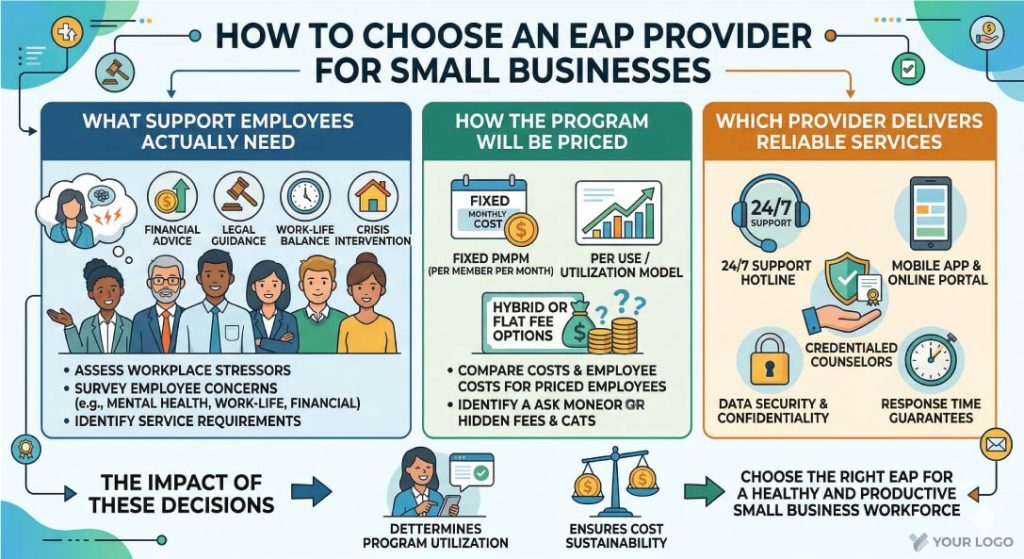
The expense of eap programs varies depending on business size, services provided, and company type. Some service providers charge per worker, while others offer bundled prices. Digital platforms like Yuna frequently supply more scalable and cost-efficient choices compared to conventional designs. EAP services typically include psychological health therapy, tension and burnout support, relationship assistance, crisis intervention, and office performance assistance.
Employees can log into the platform and begin using features like everyday check-ins, guided reflection, and AI psychological health coaching without scheduling sessions. Employers looking for contemporary staff member assistance program suppliers can choose Yuna for a scalable and easy-to-implement service.

Employee Support Programs are private workplace-based mental health support services that offer counseling, mental resources, and healing interventions to California's labor force of over 19 million people and their households through employer-sponsored efforts (California Employment Development Dept., 2024). These workplace psychological health programs incorporate directly with California's extensive healthcare infrastructure, where more than 90% of locals have access to usual health care sources such as individual doctors or centers, producing a smooth support network for staff member wellness (California Health Interview Survey, 2021).
Expert EAP Solutions for 2026
Census Bureau, 2023). California's employee assistance efforts work as main avoidance tools that lower workplace stress, prevent psychological health crises, and supply early intervention services before conditions need extensive clinical treatment, supporting the state's 18.4 million utilized employees across diverse markets from technology to agriculture (California Employment Development Dept., 2024).
These workplace-based help initiatives work as structured staff member support group that link workers with licensed mental health experts, compound abuse specialists, and household treatment resources at no charge to individuals. California employers implement these personal programs to address personal difficulties affecting workplace productivity, with over 90% of Californians having access to healthcare resources consisting of employer-sponsored mental health services (California Health Interview Survey, 2021).
These employer-funded assistance resources deal with the state's considerable psychological health obstacles, especially appropriate given California's 14% adult asthma frequency and stress-related health conditions that affect employee efficiency (California Health Interview Survey, 2022). Program individuals access confidential telephone consultations, face-to-face therapy visits, and online mental health resources created to help employees in handling both personal and professional difficulties impacting their workplace efficiency.
Employee Voluntary Benefits GuideEmployees gain access to private support services covering psychological health, drug abuse, financial therapy, and household problems within California's 18.4 million-person labor force (California Employment Development Dept., 2024). These workplace help programs work as intermediary services connecting workers to California's healthcare network, that includes over 150,000 active doctors and 450,000 signed up nurses (California Board of Registered Nursing, 2023).
EAP organizers maintain confidential intake processes where workers receive preliminary assessments and referrals to external psychological health suppliers within 24-48 hours of preliminary contact. California's varied labor force, with over 40% speaking languages besides English in the house (U.S. Census Bureau, 2023), receives multilingual support services that connect to the state's comprehensive health care facilities covering metropolitan and rural communities.
Innovative Workplace Wellness Initiatives in 2026
These worker help programs provide immediate mental support through 24/7 crisis hotlines and provide to 6-8 sessions per issue yearly at no expense to workers. EAP psychological health interventions attend to workplace tension, household disputes, substance abuse concerns, and trauma-related psychological distress within California's varied workforce of over 39 million residents (California Department of Financing, 2025).
Household conflict resolution services offer mediation support for domestic issues, while workplace injury interventions assist staff members process crucial events and occupational stress. These programs integrate with California's healthcare system where over one-third of locals are enrolled in Medi-Cal (California Dept. of Healthcare Providers, 2024). EAP counselors coordinate referrals to long-lasting psychological health suppliers when employees require prolonged mental treatment beyond the short-term intervention design.
California's 18.4 million used workers gain EAP eligibility from their very first day of work, with programs extending coverage to spouses, children, and household dependents (California Employment Advancement Dept., 2024). The state's varied workforce take advantage of culturally skilled EAP services, dealing with the needs of 27% foreign-born residents who represent over 10 million Californians (U.S.
EAP access includes multilingual support services, showing California's linguistic variety where 40% of residents speak non-English languages at home (U.S. Census Bureau, 2023). Work status variations impact EAP availability throughout California's workforce sectors. Full-time workers receive comprehensive EAP advantages consisting of mental health counseling, monetary consultation, and crisis intervention services. Part-time employees maintain equivalent program gain access to under California labor laws, though advantage utilization rates differ by 20-30% compared to full-time personnel according to office wellness research.

Latest Posts

Professional Guidance for 2026 Small Company Health Coverage

Top Dental Insurance for Employees

Investing in Workplace EAP Resources